SAVE the BEE is heading to IFT (https://www.ift.org), the leading food science and innovation expo in the world, because the food industry is having the right conversation, but not always early enough.
Across food science, ingredient innovation, product development, sourcing, and sustainability, companies are asking serious questions about the future. How do we build stronger supply chains? How do we source better ingredients? How do we reduce risk? How do we meet consumer expectations without making empty promises? How do we keep food affordable, available, and trustworthy in a world where agriculture is under pressure?
These questions matter. They sit at the center of almost every conversation happening across the food industry right now.
But there is one question that still does not get asked enough.
What makes the ingredient possible in the first place?
That is why we are going to IFT. Not because SAVE the BEE sells an ingredient. Not because we are part of the processing chain. Not because we are trying to become another sustainability logo on a package. We are going because pollinators sit beneath so much of what the food and ingredient industries depend on, and too often they are treated as a side issue instead of a source issue.
No pollination. No crops. No ingredients.
That may sound simple, but it changes the conversation. It pushes us upstream, before the supplier agreement, before the product spec, before the formulation meeting, before the finished good. It asks the food industry to look not just at where ingredients come from, but at how they come into being.
Born From the Ingredient Industry
For SAVE the BEE, this conversation is personal. Our organization was originally founded by GloryBee (https://glorybee.com), an ingredient company that understood early on that bees were not separate from the food business. They were central to it. GloryBee saw, through its own work in honey, ingredients, sourcing, and agriculture, that pollinator health was not just an environmental concern. It was a food system concern. Today, SAVE the BEE is an independent nonprofit, and GloryBee continues to be a strong supporter of the mission. But that origin matters. An ingredient company helped begin this work because it saw what was at stake.
For ingredient companies, this is not abstract. It is practical. If you work with fruit, nuts, seeds, oils, spices, botanicals, vegetables, forage crops, or plant-based inputs, pollinators are likely connected to your business. They may not appear on your balance sheet. They may not show up in your logistics dashboard. But they are there, working before the rest of the supply chain can begin.
Seed companies should care because pollination is directly tied to the reproduction of many crops. Without healthy pollinator populations, seed production becomes harder, less reliable, and more expensive. That matters to agriculture. It matters to growers. And it matters to every food company that depends on consistent crop production year after year.
Dried fruit producers should care because much of their business begins in bloom. Apricots, cherries, berries, figs, apples, plums, dates, and many other fruit crops rely on healthy ecosystems and, in many cases, pollinator activity to produce the quality and volume the market expects. By the time fruit is dried, packaged, shipped, and sold, the pollination story may feel far away. But it is still the beginning of the product.
Ingredient suppliers should care because they sit in the middle of a chain that can only be as strong as its source. A supplier can manage quality, documentation, pricing, warehousing, and customer service with great care. But if the crop behind the ingredient becomes less reliable, the entire chain feels it. Pollinator health is not the only pressure on agriculture, but it is one of the pressures companies can no longer afford to ignore.
Flavor houses should care because flavor begins in plants. Citrus. Vanilla. Mint. Lavender. Berry. Apple. Almond. Coffee. Cacao. Botanicals. Spices. So many flavors are rooted in crops that depend on healthy farm systems. Even when the finished flavor is processed, extracted, blended, or replicated, the original sensory language of food comes from the living world. Pollinators are part of that story.
Distributors should care because availability is their business. When crops are strong, supply flows. When crops are stressed, every link downstream feels the strain. A distributor may not be planting habitat or managing hives, but it still has a stake in whether the farm systems behind its product categories remain healthy and productive over time.
This is where the food industry often draws the circle too small. Companies think about their direct suppliers, their direct customers, and their direct costs. That is understandable. Business has to work. Margins matter. Lead times matter. Contracts matter. But the deeper truth is that food companies are tied to living systems whether they talk about them or not.
Bees make that connection visible.
They remind us that food is not only manufactured. It is grown first. It is made possible by soil, water, weather, habitat, labor, farming knowledge, biodiversity, and the movement of pollinators across the landscape. The industry can improve what happens after harvest in a thousand ways, and it should. But none of that replaces the work that has to happen before harvest.
This is not about asking companies to become bee charities. That would miss the point. The real opportunity is to help companies understand that supporting pollinator health is a practical investment in the agricultural systems that support their own future.
It is also a way to make sustainability more concrete. Many companies want to talk about regenerative agriculture, responsible sourcing, nature-positive business, and supply chain resilience. Those terms can become vague fast. Pollinators bring the conversation back to something people can understand. A bee visiting a flower. A crop setting fruit. A farmer bringing that crop to market. An ingredient company helping move that crop into the food system.
That is a story people understand because it is real.
And it gives companies a better way to act. They can support habitat. They can fund research. They can educate employees and customers. They can work with growers and suppliers to understand pollinator dependence across key crops. They can align sustainability goals with food system health. They can invest upstream, where small actions may help prevent larger problems later.
The companies that understand this will be better positioned than the companies that wait. Not because every food business needs to make bees its central cause, but because every food business needs to understand the conditions that make its ingredients possible.
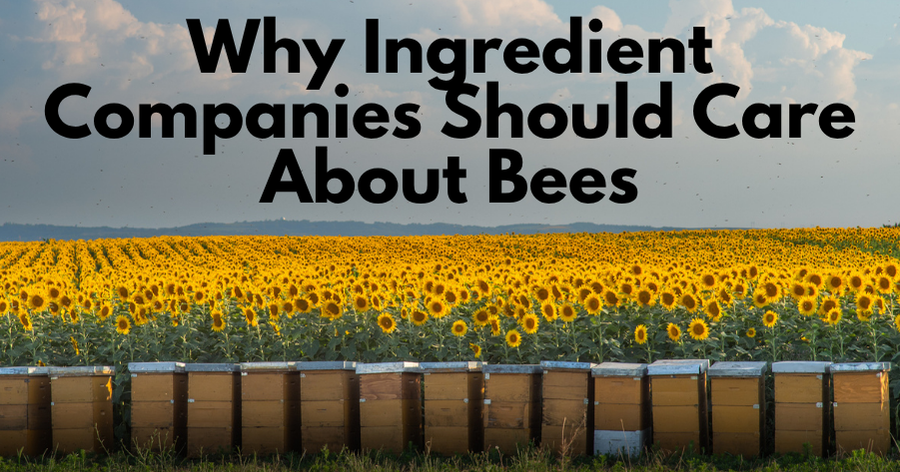
That is why ingredient companies should care about bees. Because pollination is not decoration on the edge of agriculture. It is part of the engine. Because bees are not just a symbol of nature. They are workers in the food system.
Because the future of food will depend not only on better labs, plants, packaging, and processing, but on healthier landscapes, stronger farm systems, and the living infrastructure we have taken for granted for too long.
At IFT, we want to have that conversation with the people shaping what food becomes next. The scientists. The suppliers. The formulators. The distributors. The brand leaders. The sustainability teams. The people who know how complex food really is.
And we want to ask a simple question.
If your business depends on ingredients, what are you doing to protect what makes those ingredients possible?