At IFT, people come together to talk about the future of food. That future is often framed through technology, ingredients, formulation, processing, packaging, nutrition, sustainability, and supply chain resilience.
All of that matters.
But food security starts long before food reaches a shelf.
It starts before a product is formulated, before an ingredient is purchased, before a crop is harvested, and before a supplier can promise volume, quality, or consistency. It starts in the living systems that make food possible in the first place.
And for much of the food we depend on, those systems include pollinators.
That is why Save the Bee is bringing this conversation to IFT. We are not there to tell food companies that bees are the only answer to food security. They are not. Food security is complex. It involves farmers, water, soil, labor, infrastructure, trade, affordability, climate, science, policy, and markets.
But we are there to say something simple and true.
If we care about the future of food, we have to care about the future of pollination.
The world is still growing. The United Nations’ 2024 population projections put the global population at about 9.7 billion people by 2050. That means the food system will need to support more people, under more pressure, with less room for waste, fragility, and short-term thinking.
But the challenge is not just producing more calories. That is the trap.
A food-secure future cannot be built only on volume. It has to be built on diversity, nutrition, resilience, and access. People need enough food, yes. But they also need food that supports health. Fruits. Vegetables. Nuts. Seeds. Legumes. Spices. Oils. Forage systems that support livestock. Crops that bring color, flavor, texture, culture, and nutrition to the table.
That is where pollinators matter.
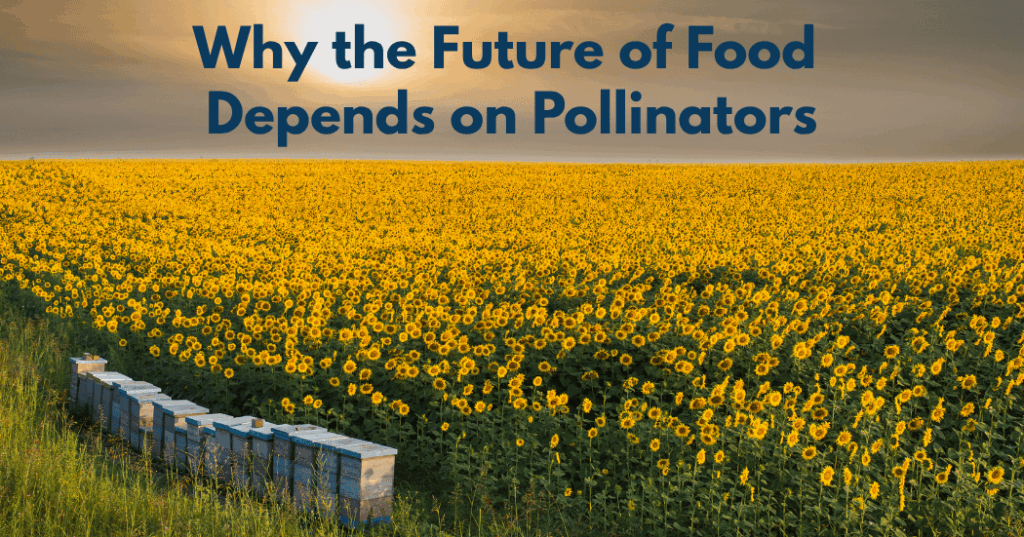
The Food and Agriculture Organization notes that about three quarters of the world’s most productive crop plants depend, at least in part, on pollinators. Pollination also connects wild ecosystems with agricultural production, which is a more important idea than it first sounds. It means food is not separate from nature. It is tied to it.
Not every crop needs bees. Corn, wheat, and rice can feed a lot of people without animal pollination. That matters, and we should say it plainly.
But a future built only around staple calories would be a thinner future. Less colorful. Less nutritious. Less flavorful. Less human.
Pollinators help support the crops that make diets more diverse and more nourishing. Research led by Harvard has linked inadequate pollination to reduced production of fruits, vegetables, and nuts, and to health risks tied to lower consumption of those foods.
That is the piece the food industry cannot afford to miss.
Pollinators are not just about whether we have honey. They are not just about whether a few specialty crops do well. They are part of the system that supports the ingredients behind juices, sauces, snacks, baked goods, beverages, nutrition products, flavor systems, dried fruits, natural colors, plant-based foods, and so much more.
For ingredient companies, food security is not an abstract global issue. It shows up as crop availability. Price volatility. Quality changes. Supplier risk. Reformulation pressure. Customer questions. Sustainability expectations. It shows up when the crop behind the ingredient becomes less reliable.
That is why pollinator health belongs in the supply chain conversation.
A company can have strong procurement systems and still be exposed if the agricultural base weakens. A brand can make bold nutrition claims and still depend on fragile farm systems. An ingredient supplier can manage documentation, storage, transportation, and customer service with great care, but none of that replaces the work that has to happen before harvest.
Food security starts upstream.
It starts in soil, water, weather, habitat, biodiversity, farming practices, and the quiet work of pollinators moving through bloom.
This is also a resilience issue. Climate pressure, habitat loss, pesticide exposure, disease, land conversion, and extreme weather all put stress on pollinators and the farm systems connected to them. When landscapes lose biodiversity, they lose some of their ability to recover. When farms lose flowering habitat, pollinators lose forage. When pollinators decline, many crops become harder to produce well.
That affects farmers first.
Then it affects suppliers.
Then manufacturers.
Then brands.
Then customers.
By the time a food product reaches a shelf, the story has already passed through a long chain of living and human systems. We notice the shelf because that is where the transaction happens. But the future of food is decided much earlier.
At IFT, the food industry will talk about what comes next. Better ingredients. Better processing. Better nutrition. Better technology. Better ways to feed people in a changing world.
Good. We need all of it.
But we also need to protect the biological infrastructure that helps make food possible. Bees and other pollinators are not outside the food system. They are part of its first shift…
…before the factory.
…before the formulation.
…before the freight.
…before the shelf.
There is a crop trying to become food.
And often, there is a pollinator helping it get there.