Summer is here.
Farmers markets are filling up again. Backyard gardens are waking up. Roadside blackberries are beginning to bloom. Families are grilling outside, pouring iced tea, planning camping trips, walking through parks, and thinking about vacations, fresh food, and longer evenings.
And quietly, almost invisibly, bees are at work beneath all of it.
That’s the thing about pollinators. Most of what they do happens in the background of our lives. We notice the strawberries, not the pollination. The almond butter, not the orchard. The lavender field, not the thousands of tiny flights happening flower by flower under the summer sun.
But the deeper you look, the harder it becomes not to see bees everywhere.
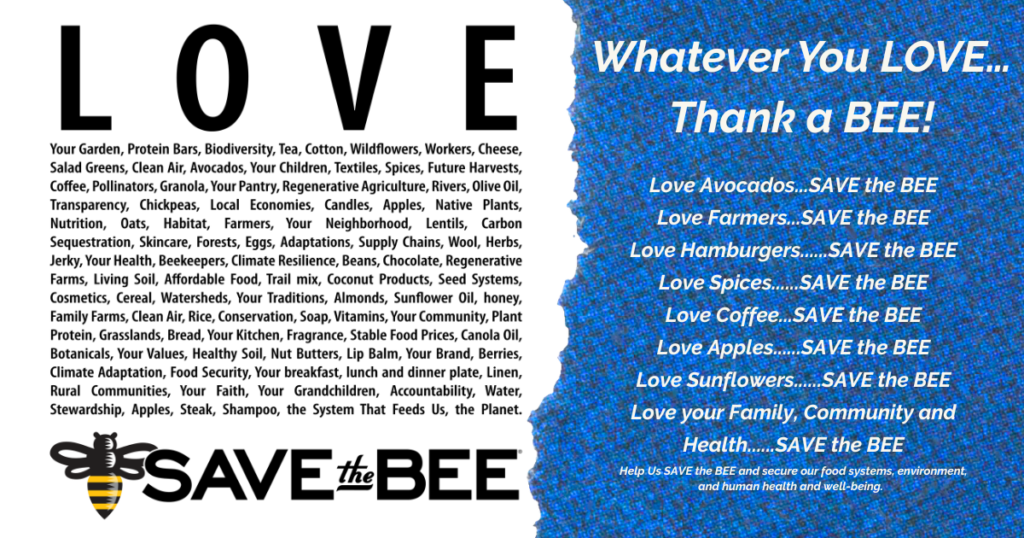
Whatever you LOVE…thank a BEE.
Your morning coffee.
Summer berries.
Wildflowers along the roadside.
Healthy soil.
Trail mix.
Cotton shirts.
Herbal tea.
Granola.
Apples.
Avocados.
Chocolate.
Seeds.
Spices.
Protein bars.
Family farms.
Biodiversity.
Clean air.
Your garden.
Your local food system.
Even many of the foods connected to livestock production begin with pollination. Bees help support the forage crops that feed dairy cattle and livestock across agricultural systems. Which means pollination quietly touches milk, cheese, eggs, and countless foods most people never associate with bees at all.
And honestly, it goes deeper than food.
Pollinators sit at the intersection of biodiversity, climate resilience, regenerative agriculture, healthy watersheds, rural economies, and environmental health. Healthy pollinator ecosystems help support stronger ecosystems overall. They contribute to healthier landscapes that absorb carbon, stabilize soil, sustain wildlife, and strengthen food security in ways most people rarely stop to think about.
That’s what makes bees so extraordinary.
A bee leaves the hive weighing less than a paperclip and somehow participates in sustaining entire ecosystems and food systems that billions of people depend on.
No headlines.
No applause.
Just work.
But the systems bees support are under growing pressure.
Across North America, beekeepers continue reporting alarming colony losses tied to habitat decline, pesticide exposure, disease pressure, climate stress, poor forage diversity, and increasingly unstable environmental conditions. Native pollinators face many of the same pressures as wild spaces shrink and ecosystems become fragmented.
And the newest research coming out of Oregon this year reinforces something important: there is no single solution.
Protecting pollinators means protecting habitat. It means supporting biodiversity.
It means rethinking how we manage landscapes. It means supporting farmers, researchers, educators, restoration efforts, and conservation organizations willing to do long-term work instead of chasing short-term headlines.
Because this is no longer just a conversation about bees.
It’s a conversation about the future of food…
…the resilience of ecosystems.
…the stability of agriculture.
…the health of our communities.
…nd ultimately, the kind of world we want future generations to inherit.
At Save the Bee, that’s why our work goes beyond awareness alone.
Through pollinator habitat restoration, education, advocacy, research support, and community partnerships, we’re working to build practical long-term solutions that help support bees, beekeepers, farms, biodiversity, and the ecosystems all of us depend on.
Summer may feel abundant right now. But abundance does not happen by accident. Somewhere right now, a pollinator is helping shape the next harvest, the next bloom, the next ecosystem, the next meal, the next season.
Whatever you LOVE…
Thank a BEE.
And if you believe this work matters, now is the time to help protect it.
Support Save the Bee today and help us continue building healthier habitats, stronger pollinator systems, and a more resilient future for the landscapes that sustain us all.