Dear Friend of the Bee,
Pollinator Week is almost here, and this spring I’ve been spending more time than usual with bees. A lot more time.
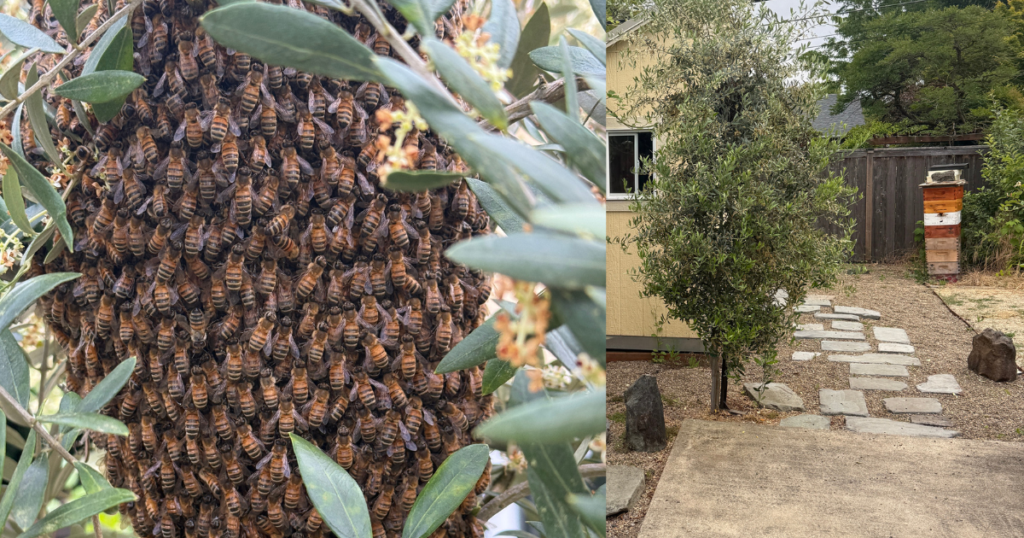
Here in Oregon, we’ve seen an incredible number of swarms this season. Colonies are growing, hives are splitting, and honey bees seem to be everywhere. In my own backyard alone, I’ve dealt with five separate swarms this spring.
At first glance, that sounds like great news. More bees. More colonies. More pollination.
Problem solved, right?
Not exactly.
Last week I had the chance to get up close and personal with one of those swarms. The bees had settled overnight in an ornamental olive tree just outside my house. Their cluster swaddled around the narrow trunk and branches was at my eye-level and easily within my reach.
If you’ve never stood inches from thousands of honey bees gathered in a swarm, it’s hard to describe. Most people expect chaos. Noise. Aggression.
Instead, they’re remarkably calm.
The colony is between homes. They’ve left one hive behind and haven’t yet found another. They’re carrying no brood, no honey stores, and no territory to defend. They simply hang together, waiting while scout bees search for a new place to live.
As the morning sun warmed the cluster, I stood there watching them and eventually helped relocate them into a new hive.
And it got me thinking…
What Would Happen If Bees Disappeared?
If someone had walked into my backyard that morning, they probably would have assumed honey bees were doing just fine.
After all, there were thousands of them right in front of us.
But that’s one of the challenges with understanding pollinators.
What we see and what’s actually happening aren’t always the same thing.
Honey bees are incredibly resilient. They survive harsh winters, parasites, pesticides, disease pressure, habitat loss, and changing weather patterns. Every spring they do what healthy colonies have always done. They grow. They reproduce. They swarm.
Yet despite those remarkable abilities, beekeepers across North America continue to report colony losses at levels that would have been unthinkable just a few decades ago.
That’s the paradox.
The bees in my olive tree represented growth, renewal, and survival.
But they also reminded me how much work remains.
Pollinator Week is next week and it isn’t about celebrating bees because they’re cute, fascinating, or because we enjoy honey. It’s about recognizing the role pollinators play in holding together the food systems and ecosystems we depend on every day.
When people ask what would happen if bees disappeared, they’re asking the wrong question.
The better question is this:
What happens when we stop paying attention before they do?
Because the future of pollinators won’t be decided by one dramatic event. It will be shaped by thousands of decisions about habitat, agriculture, education, research, and conservation.
The good news is that those are decisions we can still influence.
That’s why Pollinator Week matters.
Starting next week, Save the Bee will be taking that message directly into our community.
We’ll be visiting local businesses throughout the Eugene-Springfield area with our observation hive, meeting people where they live, work, shop, and gather. Partners including EDMS Printing and Mailing Experts, Market of Choice, Bi-Mart, Long Meat Market, Scooters Car Wash, GloryBee and others are helping us create opportunities for people to get up close and personal with honey bees in a way that few ever experience.
One of my favorite moments at these events is watching people approach the observation hive for the first time. Most start a few feet back. They’re curious, but cautious. Then they realize the bees are safely behind glass. They move a little closer. Before long, they’re searching for the queen, pointing out worker bees, and asking questions they never expected to ask.
The transformation happens quickly. A bee stops being an insect. It becomes part of a story about food, farming, flowers, wildlife, and the choices we make every day.
That’s what happened to me standing in front of that swarm in my olive tree. The closer I looked, the more I understood there was much more happening than I could see at first glance.
My hope is that Pollinator Week creates that same experience for others. Because when people connect with bees, they begin to understand something important: Pollinators don’t just support nature. They help hold our world together.
If you see us out in the community during Pollinator Week, stop by and say hello. Take a look inside the hive. Ask a question. Bring your kids.
You might leave seeing bees a little differently than when you arrived.
Bee Fact of the Day
A single healthy honey bee colony can grow so rapidly in spring that it divides itself in two through a process called swarming, creating a new colony and a new queen in the process.
Thank you for being part of the hive.
With gratitude,
Eric Mason
Executive Director, SAVE the BEE