Regenerative agriculture is having a moment.
That is a good thing. For years, farmers, ranchers, soil advocates, conservation groups, food companies, and agricultural researchers have been pushing for a deeper conversation about how we grow food. Not just how much we produce, but how we care for the land that makes production possible.
Now that conversation has moved into the national spotlight.
In late June, the White House issued an executive order focused on advancing regenerative agriculture and strengthening American farm resilience. The order points to soil health, input costs, precision agriculture, research, education, farm profitability, public-private partnerships, and stronger rural economies. It also connects regenerative agriculture to the broader goal of building a healthier, more abundant, and more affordable food supply.
SAVE the BEE does not exist to provide political commentary. That is not our lane. But we do pay attention to food policy, agriculture, conservation, and the systems that affect bees. And when regenerative agriculture becomes part of a national policy conversation, we believe it is worth taking seriously.
There is a lot in the order that points in the right direction. Soil health matters. Farmer profitability matters. Reducing unnecessary chemical dependence matters. Research and education matter. Public-private partnerships matter. A food system that is healthier, more resilient, and more connected to the land is exactly the kind of conversation more companies, agencies, and communities should be having.
But there is also something important missing.
Pollinators.
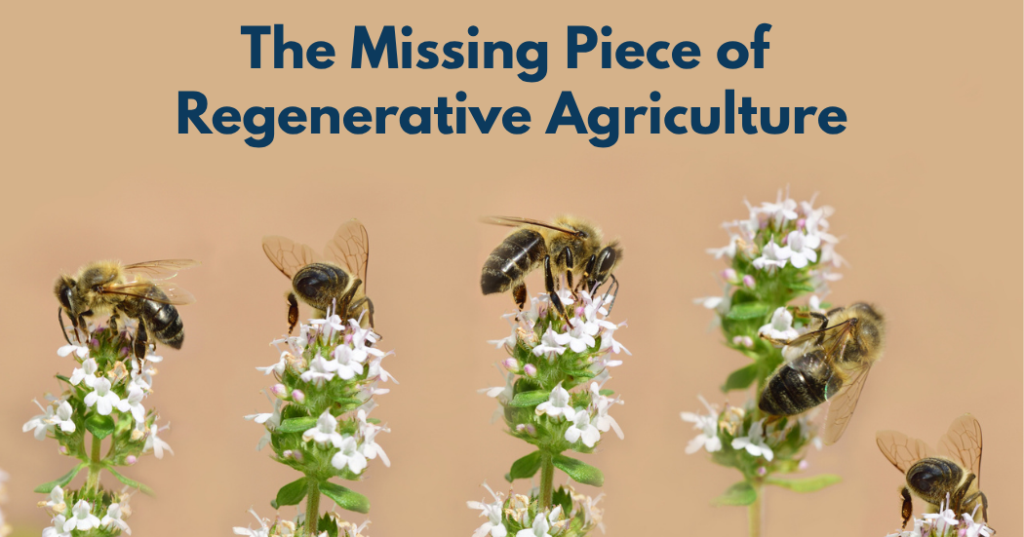
That absence matters because regenerative agriculture is often described through soil, water, carbon, grazing, cover crops, and farm economics. All of those pieces are important. But a truly regenerative system cannot stop at the ground. It also has to account for the life moving above it.
Bees. Butterflies. Moths. Beetles. Flies. Native pollinators. Managed honey bees. The whole living network that helps flowering plants reproduce and helps food systems keep producing.
If regenerative agriculture is about rebuilding the health of farm ecosystems, then pollinators cannot be treated as an afterthought. They are part of the system. They help connect habitat to harvest, biodiversity to production, and healthy landscapes to the food supply.
That is the conversation SAVE the BEE is bringing to IFT.
At IFT, the food and ingredient industry gathers to talk about innovation, sourcing, formulation, manufacturing, sustainability, and the future of food. These conversations are important. But the future of food does not begin only in a lab, a factory, or a supply chain dashboard. It begins in living systems.
And regenerative agriculture, if it is going to mean what we need it to mean, has to include pollinators.
Think about what regeneration is supposed to do. It should restore function. It should build resilience. It should make farms and food systems healthier over time, not just less harmful. It should improve soil, protect water, support biodiversity, strengthen farmer livelihoods, and create agricultural systems that can keep producing food for the next generation.
Pollinators sit right in the middle of that work.
They support crop production. They help maintain plant diversity. They connect wild habitat with working farms. They remind us that agriculture is not only a mechanical system of inputs and outputs. It is biological. It is relational. It depends on soil organisms, flowering plants, insects, weather, water, farmers, and land management choices that either strengthen or weaken the whole system.
That is why pollinators belong in the regenerative agriculture conversation.
Not as a symbol.
As infrastructure.
A farm can improve its soil and still be missing habitat. A company can talk about regenerative sourcing and still overlook the pollinator systems behind its ingredients. A policy can support agricultural resilience and still leave out one of the most visible signs of whether a landscape is alive and functioning.
This is not about criticizing the regenerative agriculture movement. It is about making it more complete.
The executive order’s focus on research and education creates an opening. So does its emphasis on public-private partnerships. If food companies, ingredient suppliers, farmers, researchers, and agencies are going to work together to strengthen American agriculture, then pollinator health should be part of that work from the start.
That means asking better questions.
- Are regenerative agriculture programs measuring pollinator habitat?
- Are they supporting flowering cover crops, hedgerows, field borders, and reduced-risk pest management?
- Are they helping farmers create landscapes where bees and other pollinators can actually survive?
- Are food companies connecting their sustainability goals to the pollinator needs of the crops they depend on?
- Are ingredient companies looking upstream far enough to understand the living systems behind their supply chains?
These are practical questions. And they matter because pollinators are not separate from food production. They are part of how food production works.
For ingredient companies, this is especially clear. Almonds, berries, apples, melons, seed crops, spices, botanicals, forage crops, and many other agricultural inputs depend, directly or indirectly, on pollination. If those crops matter to the food industry, then the pollinators behind them should matter too.
Regenerative agriculture gives us a better way to talk about food systems. It helps move the conversation beyond yield alone and toward resilience, health, and long-term stewardship. But if bees and other pollinators are missing from that conversation, then we are still not seeing the whole picture.
So yes, let’s talk about soil.
Let’s talk about water.
Let’s talk about carbon, grazing, cover crops, farmer profitability, rural economies, and the future of American agriculture.
But let’s also talk about the flower.
Because if the goal is to regenerate the systems that feed us, we have to protect the living workers that help those systems bloom, reproduce, and produce food.
Regenerative agriculture without pollinators is not wrong.
It is unfinished.
And at IFT, that is the conversation we want to help bring to the table.