For years now, the phrase “Save the Bees” has become part of the public conversation.
You see it on seed packets, social posts, documentaries, backyard gardens, food packaging, and fundraising campaigns. And honestly, that awareness matters. A decade or so ago, most people rarely thought about pollinators at all.
But something else is happening now. The conversation around bees is becoming more informed. More layered. More complicated.
And maybe that’s exactly where it needs to go.
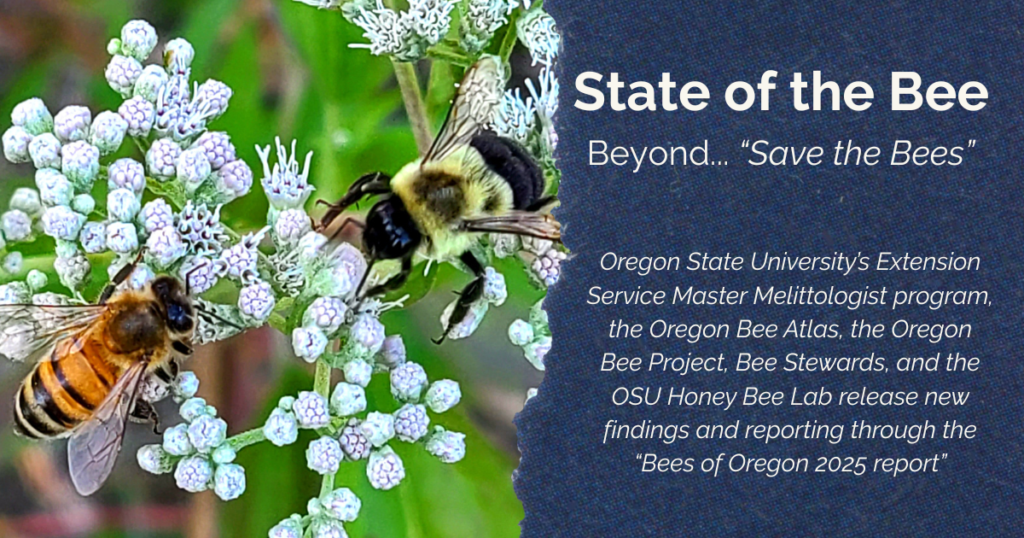
On World Bee Day 2026, Oregon State University’s Extension Service Master Melittologist program, the Oregon Bee Atlas, the Oregon Bee Project, Bee Stewards, and the OSU Honey Bee Lab released new findings and reporting through the “Bees of Oregon 2025 report”, offering one of the clearest pictures yet of Oregon’s pollinator landscape and the growing complexity surrounding bee conservation.
At the same time, the release builds on conversations already underway across the scientific and conservation communities, including last year’s widely discussed OSU Extension publication, “The Impact of Beekeeping on Native Bees in Urban Settings,” which explored the increasingly debated relationship between honey bees and native bees in Oregon.
Together, the emerging research paints a picture that is both hopeful and sobering. Hopeful because Oregon remains one of the most important places in the country for bee biodiversity research and conservation. Sobering because the deeper scientists look into pollinator ecosystems, the clearer it becomes that there is no single bee story anymore.
At Save the Bee, we believe that matters.
Because protecting pollinators was never going to be solved through slogans alone.
Science evolves. Ecosystems are complex. And the more we learn, the clearer it becomes that “saving the bees” cannot mean just one thing anymore.
Here are five of the biggest takeaways we see emerging from Oregon’s newest reporting.
1. Oregon’s Bee Biodiversity Is Extraordinary
One of the clearest messages coming out of the Bees of Oregon 2025 findings is just how vast and underappreciated Oregon’s bee diversity really is.
Most people think of bees as either honey bees or bumble bees. But Oregon is home to roughly 900 bee species. Some are tiny enough to resemble gnats. Some nest underground. Some specialize on only a narrow range of plants. Others survive by parasitizing other bee species.
And while the public conversation often centers on a handful of recognizable pollinators, researchers and volunteers across Oregon are documenting an entire hidden ecosystem most people never see.
The Oregon Bee Atlas has now become one of the largest contemporary wild bee surveys in the United States, helping identify bee biodiversity hotspots, track species distribution, and better understand how Oregon’s native pollinators interact with changing landscapes.
That work matters because you cannot protect what you do not understand. And we are still only beginning to understand the true complexity of the pollinator world around us.
2. The Science Around Honey Bees and Native Bees Is More Nuanced Than Public Debate Suggests
One of the most important supporting conversations surrounding this year’s reporting comes from the 2025 OSU Extension publication examining the impact of urban beekeeping on native bees.
Over the last several years, public discussion has increasingly framed honey bees and native bees as competing sides of the same conservation issue.
The research suggests reality is far more complicated.
The report acknowledges legitimate concerns around competition for forage, disease transfer, and ecological pressure. But it also repeatedly emphasizes that many of these relationships remain highly contextual and scientifically unresolved.
Some studies demonstrate competitive impacts. Others show adaptation among bee species or limited long-term effects. A broad review cited in the report found that only about half of studies reviewed showed negative competitive outcomes.
The findings also reinforce something important: different bee species often utilize landscapes differently. Some flowers heavily attract honey bees while others are dominated by native specialists. Some native bees adapt their foraging behavior when conditions change.
None of this means competition never occurs. But it does mean the issue deserves more nuance than social media headlines often allow.
3. Habitat Continues to Be the Defining Issue
If there is one theme connecting nearly all modern pollinator research, it is habitat.
- Habitat loss.
- Habitat fragmentation.
- Habitat degradation.
Again and again, the Oregon findings reinforce that healthy forage and intact ecosystems remain central to pollinator survival. That includes native flowering plants, urban pollinator corridors, agricultural forage systems, healthy watersheds, and the preservation of intact native landscapes where rare bee species continue to survive.
Importantly, the research also draws a distinction between different conservation priorities. Urban and agricultural areas may support coexistence between honey bees and many common native bee species when floral resources are abundant and thoughtfully managed.
But Oregon’s rarest bee species are often found far from cities in highly specialized ecosystems connected to specific native plant communities.
That changes how conservation must work. Different bees need different strategies. Different landscapes require different solutions.
And protecting pollinators likely depends less on choosing sides and more on restoring ecological balance where bees actually live.
4. Beekeepers Remain Important Allies in Pollinator Conservation
One of the more overlooked themes in the newer reporting is the continued role of beekeepers in broader pollinator advocacy.
The 2025 OSU publication pushes back against the idea that beekeeping and native bee conservation are inherently opposed. In fact, it highlights the long history of beekeepers supporting habitat restoration, pollinator education, pesticide awareness efforts, and conservation initiatives across Oregon.
Some Oregon Master Beekeepers also actively contribute to native bee surveying efforts through the Oregon Bee Atlas itself.
That reality matters.
Because pollinator conservation is becoming increasingly polarized online while many people doing the actual work on the ground remain deeply collaborative.
Most people who care about honey bees care deeply about pollinators overall. For many, honey bees became the gateway into understanding larger ecological systems in the first place.
At Save the Bee, we believe those shared goals still matter.
5. We Need to Move Beyond Simplistic Ideas About “Saving the Bees”
This may be the biggest takeaway of all from the combined body of emerging research.
There is no single pollinator story anymore. The Oregon reporting repeatedly points toward the need for more regionally specific, habitat-specific, and species-specific approaches to conservation.
Some bees depend on urban forage. Some support modern agriculture and food production systems. Some survive only in fragile alpine ecosystems or highly specialized native habitats. Some pollinate crops tied directly to human nutrition and food security. Others quietly sustain wild ecosystems most people will never even encounter.
The deeper scientists look into pollinator ecology, the more interconnected everything becomes; food systems, biodiversity, climate resilience, habitat restoration, agriculture…human health.
Bees sit at the center of all of it.
We want to acknowledge the researchers, volunteers, educators, and organizations behind this growing body of work, including Oregon State University Extension Service, the Oregon Bee Atlas, the Oregon Bee Project, Bee Stewards, and the OSU Honey Bee Lab. Their work is helping move the public conversation beyond slogans and toward a more informed understanding of pollinator health and conservation.
At Save the Bee, we believe this new research reinforces something essential:
The future of pollinators will not be protected through simplistic thinking.
.It will take science.
..It will take habitat restoration.
…It will take education.
….It will take collaboration.
And it will take people willing to care about ecosystems most never stop to notice. That is why it is more important than ever to Save the Bee.