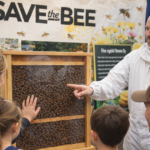
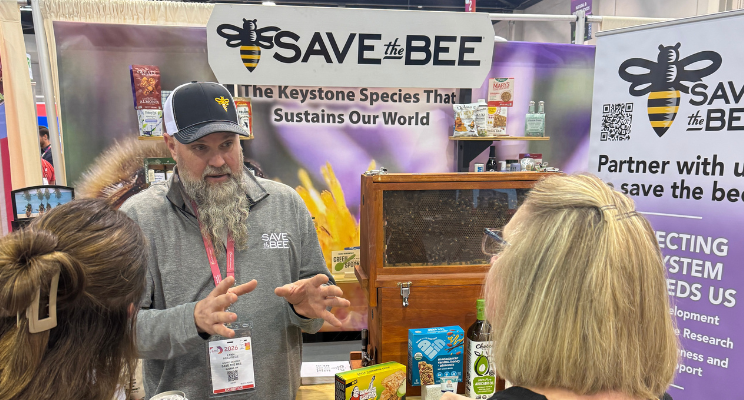
For four days at Natural Products Expo West we stood beside a living colony of bees and invited people to stop, take a look, and ask questions.
And people did.
Founders. Buyers. Retailers. Scientists. Consumers. Curious passersby who simply saw bees and wanted to know what was going on.
Over the course of the show we spoke with well over 1,000 people.
Some came ready for the conversation. They already understood that pollinators sit at the center of our food system and our environment.
But many arrived with a much simpler picture of bees in their minds.
Honey.
…And getting stung.
That’s it.
You could almost see the moment when that idea started to shift.
People would lean in toward the glass of the observation hive, looking closely at the comb, the workers moving across the frame, and eventually the queen making her slow way through the colony. There’s something about seeing a living hive up close that changes the conversation. Bees stop being an abstract environmental issue. They become real.
Then their eyes would move to the shelves beside the hive.
That’s where the second part of the story lived.
Our Bee Impact Wall surrounded the hive with products from across the Expo floor. Snacks. Oils. Cereals. Supplements. Ingredients. The lavender in soap or hand-wipe, buckwheat in baby-food, whey protein, beef sticks, eggs and ice-cream…foods and products people buy every day without thinking twice about how they begin.
More than fifty brands joined that display. Some were already partners of Save the Bee. Others simply said yes when we asked if we could feature their product as part of the story.
Because the story is simple. Bees don’t just make honey.
Bees support the crops, seeds, fruits, nuts, oils, and plant systems that make up a huge portion of what we eat. They support the livestock systems built on pollinated forage crops like clover and alfalfa.They help sustain ecosystems that keep soil healthy, water clean, and farms productive.
When people saw that connection laid out in front of them, something clicked.
You could see the light bulb moment.
Someone would point at a product they recognized. Maybe something they had eaten that morning. Then they would look back at the hive and ask a version of the same question we heard again and again.
“Wait… bees are connected to this too?”
Yes. They are.
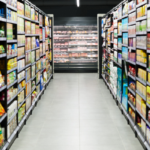
In fact, when you walk the aisles of Expo West, a large portion (we did our back of the napkin math and estimate 50-60%) of what fills those shelves exists because pollinators are doing their job somewhere in the background.
The abundance we see at shows like Expo West doesn’t happen by accident. It begins in fields, orchards, and ecosystems that rely on pollination.When those systems are healthy, creativity in food flourishes. Brands experiment. New products emerge. Consumers benefit from choice and innovation.
But when we start pushing those systems to the bottom, the story changes. Pollinators struggle. Fields become less diverse. Inputs rise. The system starts looking for shortcuts. Cheap substitution becomes the trade-off. Ingredients get replaced. Quality slips. Nutrition erodes.
And the stress doesn’t stay in the field. It moves through the entire food chain.
That’s why Save the Bee spends so much time talking with the food industry. Not to lecture anyone. Not to point fingers. But to connect the dots between pollinator health, the systems that feed us and our own well-being.
Expo West turned out to be the perfect place for that conversation.
People came for the bees. They stayed for the story. And more than once someone walked away saying something like this:
“I had no idea.”
Those four words tell us we’re doing exactly what we came to do. Start the conversation. Help people see the connection. And invite more of the food industry to help protect the systems that make their products possible in the first place. Because once you see it, it’s hard to unsee.
The hive. The food. The connection between them…and us. That light bulb moment is where real change begins.
Thank you again for everyone involved and those who visited our booth and asked to stay in touch with our (shared) work and mission. Contact us for more information on becoming formal licensed partner or make an individual donation at www.savethebee.org and help us Save the Bee.