I left Eugene in early March before sunrise on my way to Anaheim, California and the 2026 Natural Products Food Expo, or Expo West.
It was the kind of gray morning that still feels like the dead of winter no matter what the calendar says. Oregon hadn’t tipped yet. The trees were bare, the fields quiet, and if you didn’t know better, you’d think spring was still more than a few weeks out. But somewhere south of the state line, that illusion started to break. Spring, at least for the bees in California, had already started weeks earlier.
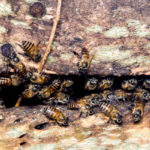
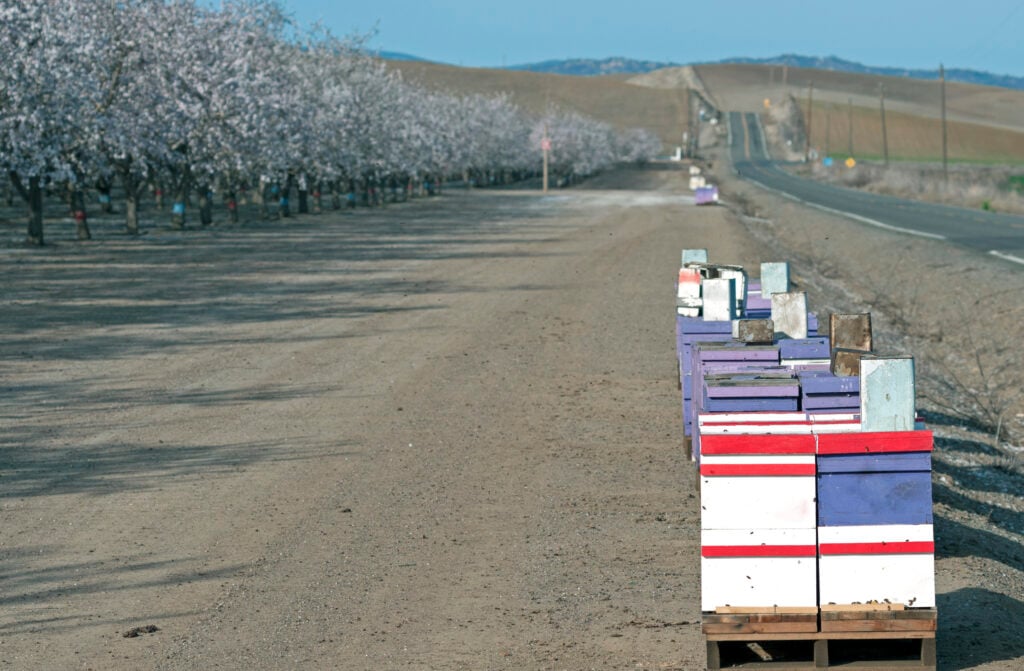
As I made my way down I-5 and passed Mt Shasta and descended into and through Redding, the landscape began to open up. The road straightened, the valleys widened, and the fields stretched out in long, uninterrupted lines. That’s when I started to notice them. At first it was just a few boxes set back from the road, easy to miss if you weren’t looking. Then more appeared. Then clusters. Then entire fields edged with them. Wooden hives, stacked low, scattered across the landscape in a way that didn’t feel accidental. They looked placed. Intentional. And suddenly it was clear that this wasn’t just part of the scenery. This was the reason for it.
Along this stretch of highway sits one of the most concentrated and consequential events in American agriculture. Each year, somewhere between eighty and ninety percent of the country’s commercial honeybee hives are brought here to pollinate California’s almond crop. That’s roughly 2.5 million hives, moved from nearly every corner of the country, converging in a single region for a single purpose. It’s hard to wrap your head around that kind of scale until you see it. Mile after mile, field after field, and just beyond the tree lines, the infrastructure that makes it all possible quietly hums along.
What struck me most wasn’t just the number of hives, but the timing. Back home, spring hadn’t started. Here, the bees were already deep into their first major pollination event of the year. There’s no gradual transition for them, no slow warming of the season. They are transported, unloaded, and set to work almost immediately in an environment that offers little beyond the crop they’re there to serve. Almond orchards bloom all at once and then disappear just as quickly, leaving behind vast stretches of land with limited nutritional diversity. It’s a system built for efficiency, not resilience.
And almonds are only the beginning. Once this bloom ends, those same hives will be loaded back onto trucks and sent out again, moving from crop to crop across the country. Blueberries, cherries, apples, melons. The path is long, and it doesn’t leave much room for recovery. Along the way, bees are exposed to pesticides, herbicides, and a growing list of pathogens, all while being asked to maintain colony strength and, eventually, produce honey. When people talk about the pressure on bees, this is what it looks like in practice. Not a single event, but a continuous cycle of demand.
Read more about how beekeeping has changed
Driving through it, you start to see how much of our food system depends on this narrow window of time and place. When that many hives are concentrated in one region, the margin for error shrinks. Weather shifts, forage gaps, chemical exposure, or disease can ripple outward in ways that affect far more than a single crop. It becomes less about one harvest and more about the stability of pollination across the entire system.
What often gets left out of this picture are the beekeepers themselves. Behind every one of those hives is a person managing risk that most people never see. They move their colonies across state lines, track bloom cycles, negotiate contracts, and absorb losses that can take years to recover from. When a beekeeper exits the industry, it’s not just a reduction in hive numbers. It’s the loss of experience, infrastructure, and time. You can’t replace that overnight.
By the time I reached Southern California and the traffic thickened, the contrast was hard to ignore. Inside the convention center at Expo West, we would spend days talking about sustainability, regenerative agriculture, product innovation, and the future of food and our human well-being. Just hours north, 2.5 million beehives and 100+ billion bees were already doing the work that makes those conversations possible.
That drive, up and back, stays with me because it strips away the abstraction. It’s one thing to talk about pollination as a concept. It’s another to see the scale, the concentration, and the strain in a single stretch of highway. It raises a simple question that doesn’t have an easy answer. If this system begins to weaken, even incrementally, what replaces it?
Maybe the better question is what we’re willing to change before it gets to that point.